Spoiler notice: this article discusses major developments across the Fate, Unlimited Blade Works, and Heaven's Feel routes of Fate/stay night. Readers who have not completed the visual novel should proceed with that in mind.
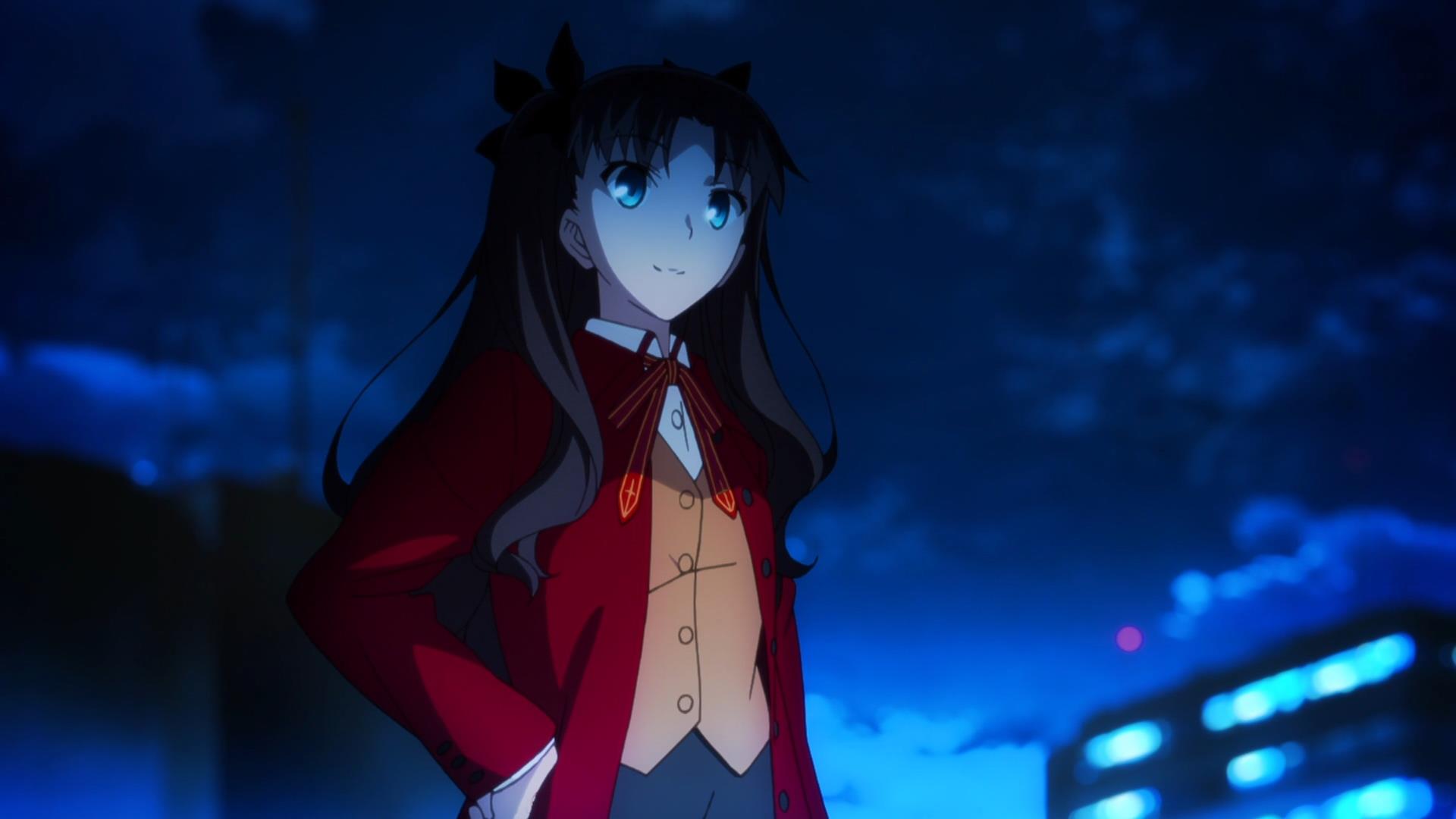
Rin Tohsaka
There is a particular kind of character who survives the passage of years not because she was designed to be liked, but because she was designed to be whole. Rin Tohsaka belongs to that category. Nearly two decades after Fate/stay night's release, she remains a reference point in conversations about anime heroines not because nostalgia has preserved her artificially, but because the contradictions she is built from continue to feel true. This piece argues that Rin is compelling precisely because she refuses to resolve into a single trait. She is proud and compassionate. Competent and fallible. Guarded and generous. Privileged and burdened. To call her "best girl" is not to claim she is flawless or universally superior to every heroine who followed her. It is to argue that few characters manage her particular balance of contradictions without collapsing into caricature, and that this balance is worth taking seriously as a piece of character craft.
First Impressions: Presence Before Personality
Rin's introduction establishes her as someone who commands a room before she says a word. She is a class representative, academically distinguished, and visually precise in a way that reads as intentional rather than incidental. This matters because first impressions in fiction often do narrative work that dialogue cannot. Before the reader knows anything about her interiority, they understand that Rin occupies space with authority. She is not shy about being seen. This is a deliberate contrast to how her private self will later be revealed, and the gap between the two is where much of her characterization lives.
What keeps this presence from feeling like empty polish is that the narrative quickly complicates it. Rin's composure is shown to be effortful rather than natural, a distinction that becomes clearer as the story progresses into her family history and her nightly work as a magus. The audience is invited to admire her poise while also suspecting, correctly, that it is doing more work than it appears to.
Competence Without Infallibility
Rin's skill as a magus is central to her appeal, but competence alone rarely makes a character interesting. What makes hers compelling is that it is never treated as absolute. She is resourceful under pressure, tactically minded, and capable of improvising when her plans fail, which they frequently do. Her magecraft is built on inherited techniques she has adapted rather than mastered in some idealized sense, and the narrative is honest about the limits of her power relative to other participants in the Holy Grail War.
This matters because a character who wins effortlessly earns admiration without earning investment. Rin's battles, her miscalculations, and her willingness to adapt when her first approach fails are what make her competence feel earned rather than decorative. She is skilled enough to be taken seriously as an active participant in the plot, and imperfect enough that her setbacks carry real stakes. The combination produces a heroine whose strength never eclipses her humanity.
The Distance Between the Public Self and the Private Self
Much of Rin's characterization depends on the gap between how she presents herself and who she is when no one is required to be impressed. Publicly, she is composed, sharp-tongued, and quick to assert authority. Privately, she is shown to be domestically awkward, prone to overthinking small social situations, and uncomfortable when her carefully maintained image slips.
This gap is not played purely for comedy, though it does produce comedic beats. It functions as a window into how much effort Rin invests in appearing self-sufficient. A character who is effortlessly perfect in every context has little room for the reader to feel close to her. A character who is visibly working to maintain an image, and who occasionally fails to maintain it, becomes someone the reader can recognize. The domestic clumsiness, the flustered reactions when her control lapses, and the small inconsistencies between her public poise and private habits are not flaws bolted onto an otherwise flawless design. They are the mechanism by which she becomes legible as a person rather than an archetype.
Pride, Perfectionism, and the Weight of Inheritance
Rin's pride is frequently the first trait newcomers notice, and it would be easy to read it as simple arrogance. The narrative complicates this by rooting her pride in inheritance and obligation rather than vanity. She carries the responsibilities of the Tohsaka family and its magical lineage after her father's death, and this inheritance arrived earlier and more heavily than it should have. Her perfectionism reads less as a personality quirk and more as a coping mechanism for a responsibility she did not choose but refuses to abandon.
This is where her loneliness becomes visible. Rin's insistence on self-sufficiency, her reluctance to ask for help, and her discomfort with dependency all trace back to a household that emptied out earlier than it should have. She positions herself as someone who does not need support because she has spent years training herself to function without it. The tragedy embedded in this is quiet rather than dramatized, which is part of why it lands. She is not written as a martyr. She is written as someone managing an old wound through discipline, and the discipline is convincing enough that it can be mistaken for the absence of a wound at all.
Shirou: A Study in Contrasting Values
Rin's relationship with Shirou Emiya is one of the clearest tools the narrative uses to reveal her character, precisely because the two hold such different philosophies. Shirou's instinct is self-sacrificing to a degree that borders on self-erasure, a trait rooted in his own history. Rin's instinct is protective of resources, calculating, and skeptical of heroics that ignore practical cost. Their disagreements are rarely about affection. They are about how a person should weigh their own worth against the needs of others.
What makes this dynamic effective is that Rin does not simply soften to accommodate Shirou, nor does she remain static in opposition to him. She challenges his tendency toward self-destruction directly, frustrated by a worldview that treats his own survival as negotiable. At the same time, proximity to him exposes the parts of her that mirror his self-neglect, particularly her own difficulty accepting help. Their relationship functions less as a conventional romance escalation and more as two incompatible survival strategies colliding, each forcing the other to examine assumptions they had stopped questioning.
Across Three Routes: Consistency Through Variation
Rin's role shifts considerably depending on which route of Fate/stay night is being read, and the consistency of her core character across these variations is itself notable.
In the first route, Fate, she is drawn closer to Shirou through necessity and gradually allows him past her guarded exterior, with her vulnerability emerging in smaller, more private moments rather than through a single dramatic turn.
In Unlimited Blade Works, she is positioned as a far more central figure, and the route interrogates her ideals directly. Her belief in justice, in doing what is right regardless of personal cost, is tested against Archer's disillusionment, a version of a possible future shaped by the same convictions taken to their exhausted extreme. This route asks whether Rin's principles can survive contact with their own worst-case outcome, and her resolve to hold onto them without becoming naive is one of the most substantial character arcs given to her across the work.
In Heaven's Feel, her role recedes in centrality but not in significance. She becomes a figure of support and eventual reconciliation, particularly in her handling of Sakura's arc, and her willingness to set aside her own claims on Shirou in favor of what the situation actually requires reveals a maturity that earlier routes only gesture toward.
Across all three, the throughline is that Rin's ideals are tested rather than simply displayed. She is not written as someone whose values are correct by default. She is written as someone who has to keep choosing them under pressure, which is a more demanding form of characterization than static virtue.
Sakura: Complexity Without Simplification
Rin's relationship with Sakura Matou carries an emotional weight that resists easy summary. The two are connected by blood and by the shadow of the Matou family's history, a connection complicated by guilt Rin carries for circumstances she did not choose but benefited from. She was the sister who was spared the burden Sakura inherited, and this asymmetry sits underneath their interactions even when it is not spoken aloud.
The narrative does not resolve this into simple sisterly warmth. There is protectiveness, there is unspoken guilt, and in Heaven's Feel there is direct confrontation with the consequences of a family structure that sacrificed one daughter's wellbeing to preserve the other's. Rin's handling of this, her refusal to look away from what happened to Sakura and her active role in trying to help her, demonstrates a capacity for accountability that many characters in her position would avoid. It is one of the clearest instances of her compassion operating without the cover of pride to soften it.
Beyond "Tsundere": A Category Too Small
Rin is frequently summarized as a tsundere, and while the label is not inaccurate as a surface description, it flattens far more than it captures. The tsundere archetype, as commonly used, describes a pattern of behavior: hostility masking affection, released in predictable comedic beats. Rin does exhibit this pattern in places, but reducing her to it discards everything that makes her specific rather than generic.
Her inherited responsibility, her private domestic awkwardness, her tested ideals across three distinct routes, her complicated grief regarding her family, and her evolving accountability toward Sakura are not tsundere behaviors. They are the architecture of a person, and the tsundere moments are a small surface feature of that architecture rather than its foundation. Treating the label as sufficient description mistakes a recognizable habit for a complete character.
Visual Design as Characterization
Rin's design is frequently praised on aesthetic grounds alone, but it is worth noting how deliberately it reinforces her characterization. The red palette she is associated with reads as assertive and unapologetic, consistent with the public persona she maintains. Her twin tails are precise and symmetrical, visually echoing the discipline she imposes on herself. Her uniform is worn with a kind of exactness that suggests someone who treats appearance as another domain to be controlled rather than left to chance.
Her association with jewels, both narratively through her use of gems as magical catalysts and visually through recurring motifs, reinforces an idea running through her whole character: something valuable, cut and shaped under pressure, hard on the surface while retaining depth underneath. This is not a coincidence of art direction. It is a visual argument for the same contradiction the writing pursues, pride as a hardened surface over something more fragile.
Enduring Relevance in a Crowded Field
Anime has not stopped producing heroines since Fate/stay night's release, and many of them are well constructed, memorable, and deserving of admiration in their own right. Rin's continued relevance in this environment is not a claim that no one has matched her. It is closer to an observation that the specific combination she represents, competence without invincibility, pride without cruelty, guardedness without coldness, and privilege shadowed by real grief, remains difficult to execute well, and few characters attempt the entire combination at once. Newer heroines often specialize in one or two of these traits with polish. Rin's distinction is holding all of them together without any single trait cannibalizing the others.
It is worth acknowledging directly that her broader cultural visibility has been amplified by other characters within the same media franchise who borrow her design and voice, most notably certain Servant interpretations in later entries. Those characters are worth discussing on their own terms, but they are not Rin Tohsaka, and conflating them with her original characterization does a disservice to the specificity this article has tried to describe. Her legacy rests on the original writing, not on the reach of her silhouette.
Final Finding
Rin Tohsaka earns the designation of best girl not because she is without flaw, but because her flaws are legible, consistent, and load-bearing. Her pride is inseparable from her grief. Her competence is inseparable from her willingness to fail and adapt. Her guardedness is inseparable from a private tenderness she distrusts but cannot fully suppress. These are not decorative contradictions layered onto a simpler character underneath. They are the character, and they cohere into someone who feels, across three routes and nearly two decades of cultural memory, distinctly and stubbornly human.
That, more than any single scene or design choice, is why she has lasted. Not perfection, but the persuasive architecture of a person built from tension held rather than resolved.